
You Make Sense
How the Polyvagal Theory Teaches Us to Regulate, and therefore, Retrouvailles

As always, on this platform, I am not your doctor, this is not an office. Don’t treat these words as prescription. Take what you want, and leave the rest. If you need medical advice, please go see your doctor. If in fact, I am your doctor, come see me in clinic and we’ll get it sorted out. In case of emergency, call 9-1-1.
I’m in the phase of life where all my friends are having babies.

My sister is a mother of two, my best friend is a single mom. Four separate couples in my small group are currently expecting, and I wouldn’t be surprised if another announcement is made in the coming months.
By the end of this year, our small group will have at least nine kiddos under the age of three. (If you’d like to offer your services as small group babysitter on Wednesday nights, we are very much in the market.)
I’ve found great joy in watching all of my friends grow into parenthood. Some have been babysitting since adolescence, and some have never changed a diaper. Some waiting on this for years and others expecting when they least, well, expected to. At any given social gathering, we’ll have at least one baby passed around and held so the parents’ arms can get some respite. But at some point in the evening, that child will miss their mom, and when the tears fall, Mom is right at the ready, offering her embrace and her soothing motherly voice.
They say the reason “shhh”-ing a baby is so comforting, is because it resembles the safe, familiar sound of the womb. Nothing to worry about in there. Always nourished, never soiled, never without the warmth of a mother’s touch. I imagine that’s why skin-to-skin is a comforting close second. There’s a myriad of approaches to calm the ailing child. Some work better than others, some work well for one child and do absolutely nothing for the others. But I think we can all agree, while there is no one right answer, the absolute wrong solution is to tell that baby to:
“Relax.”
Half of you just felt a rush of anger in your bones at the sight of that word. Relax. As if it were that simple. As if a simple command, like a “Hey Siri, Remind me in two minutes that I need to chill out,” could rearrange the molecules in your mind and calm your tensed out muscles.
About thirty years ago, an American psychologist named Dr. Stephen Porges noticed the barriers to this top-down approach. In his encounters with patients, he’d witness them try to reason with their own nervous system, spout out kind thoughts and mean thoughts to try and settle the anxiety and depression in their bodies. Dr. Porges concluded that this strategy was not only ineffective; in fact, it was the opposite of what the body needed.
Dr. Porges is famous for describing what is known as the Polyvagal Theory in psychology, and in a nutshell it’s this:
The state of your nervous system determines your thoughts, not the other way around.
The nervous system he’s specifically referring to is your autonomic nervous system (ANS); this regulates the automatic processes in the body, like how fast your heart beats, or when it’s time to digest lunch. Comprised of the Sympathetic (fight or flight) and Parasympathetic (rest and digest) branches, the ANS is what allows you to stay alive even when you’re not thinking about staying alive. While the sympathetic branch contains multiple fibers stemming from the spinal cord, the primary fibers making up the parasympathetic branch come together and form two distinct circuits of the vagus nerve. Hence Polyvagal Theory.
According to the Polyvagal Theory, when it comes to stress response, the ANS exists in a hierarchy of sorts, from most rudimentary to most advanced/evolved pathways.
Ventral Vagal Regulation: The most evolved state; this is when are you relaxed, calm, safe, and connected. It is in this state that you are capable of appreciating nuance, taking risks, and being vulnerable. The ventral vagal state is marked by confidence, curiosity, and social engagement. “I can.”
Sympathetic Activation: The mid-range, mobilization state; this is when you are activated, moving, anxious tapping or running away from a bear. It is in this state that time is often compressed and volume reaches its peak. The sympathetic state is marked by anxiety, irritation, rage, and fear. "“I must now.”
Dorsal Vagal Regulation: The most reptilian state; this is when everything comes to a halt, in light of system overload. It is in this state that the mind dissociates, and numbing patterns emerge. The Dorsal Vagal state is marked by hopelessness, depression, shame and shut down. “I can’t.”
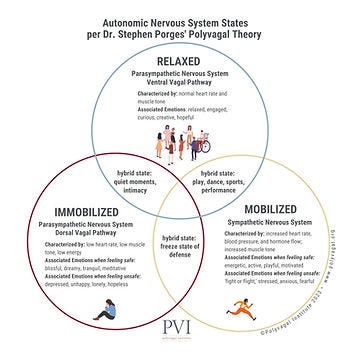
It’s an oversimplification, but for our introductory intents and purposes, we all exist in one of these states at any given time, and whichever state we are in will dictate how we respond to a stressor.
Let’s say I’ve got a big presentation to give at work today, and on my way to work, some driver cuts me off. Some mornings, this doesn’t affect me, and sometimes, it infuriates me. The Polyvagal Theory helps explain why.
Let’s say I’ve given this presentation multiple times before. It’s a presentation I enjoy, and before I left that morning, I showed it to Tommy and he told me how proud he was of me. We share a nice kiss, tell each other “I love you,” and go on our merry way. If the driver cuts me off, I’m in a Ventral Vagal State; I’m calm, relaxed, more understanding. I’d probably give him the benefit of the doubt, or simply acknowledge that it happened and continue listening to my Qveen Herby playlist.
Now, this time, let’s say my boss tells me that I’m up for a raise if this presentation goes well. It’s a presentation on a topic I still don’t fully understand, and I know some gunner in the audience is going to ask me a hard question just to prove he knows more than me. I don’t sleep well that night, I snap at Tommy the next morning and he snaps at me, and now I’m running late. If the driver cuts me off now, I’m in a Sympathetic State; I’m anxious, on edge, pressed for time. I’d probably yell at him (with the windows rolled up ‘cause I’m not that bold) and go into my presentation tense as tetanus.
Finally, let’s say I just got off a really hard rotation in the ICU. A sweet elderly woman with cancer had spent the last week fighting for her life on a ventilator. The family had come in from all over the country, and even though on Wednesday evening she was looking like she’d make a miraculous recovery, Thursday morning told a different, much sadder story. I came home and cried to Tommy, wondering if I was really helping people as a doctor, since all I seem to do is lose them. Tommy tries to remind me that at some point, everyone dies, and that my role is take part in the healing and ease their suffering. We turn on a movie, and the grandmother gets sick in the film. I try to sleep, but I’m kept up with the existential reality that the inevitable promise of life is that at some point we all die. If the driver cuts me off now, I’m in a Dorsal Vagal State; I’m depressed, I’m hopeless. I’d probably shrug my shoulders and say “Of course this would happen to me today,” and wait for it to happen again.
The situation was the same each time, but depending on the state of my nervous system, my thoughts, actions, and reactions changed.
What about you? Did you notice your own state shift with each of these examples? Were you lighthearted in the first, clenched in the second, sullen in the third?
When I first learned about the Polyvagal Theory on our drive home from Iceland, I was floored. It finally gave language to the things that were happening in my body. It gave me an explanation for why sometimes I find Tommy’s dark sense of humor funny and sometimes I find it concerning. Why sometimes I read my writing and think, “Pulitzer Prize, next in line!” and sometimes I think I should burn it all. More than anything, it helped me understand why it never worked when I, much less other people, would try to calm me down by telling me to “relax.”
Anxiety isn’t just “all in my head.” For whatever reason, my nervous system perceives a threat, and asking it to “calm down” is like asking a gazelle to chill out when it’s being chased to death by a hungry lion. The input is incongruent with the state. Therefore, the input is put in the trash can.

One of my favorite resources for Polyvagal Theory so far has been a life coach named Sarah Baldwin. She’s not a doctor, not a therapist; she’s simply a person who has seen some sh*t and lived some life, and she used the polyvagal framework to regulate her own nervous system after years of trauma and neglect. In addition to her coaching offerings, Sarah has a podcast, and she incorporates the polyvagal framework to remind her listeners that, no matter what is going on, no matter what thoughts are coming in your head or the sensations going through your body,
“You Make Sense.”
I want to remind you of that today, friend. The thoughts in your head that tell you you’re not good enough? It makes sense, not because it’s objectively true, but because somehow, somewhere, it was your mind’s only explanation for how poorly you were being treated. The constant tapping you do when you’re waiting on your dinner to arrive? It makes sense, not because it’s good for you, but because somehow, somewhere, you weren’t allowed the safety of rest and stillness. The snapping you did to your kids? It makes sense, not because it’s right, but it was the model you had as a child.
People make sense in light of their story. I think this is what it means to meet someone where they are. It’s not about condoning unkind and self-destructive behavior. It’s about looking in their rearview mirror, seeing the litany of marks, scars, opportunities, and regrets that led them to where they currently stand. We cannot move on without acknowledging where we are, and we cannot get to the peace we desire without regulating our nervous system out of the calamity it thinks it is in.
According to the polyvagal theory, the state of one’s nervous system is also influenced by the state of someone else’s. It’s called neuroception, and it’s perceived through mostly facial expressions and vocal tone. If a man looks at me with a grisly expression, I’m probably going to tense up. If woman smiles at me, I’m more likely to relax. It’s the same with babies, another reason the shh-ing sound is so calming. Soft voice, calm face. If mom feels safe, then I am safe.
I’m not a mom yet, but I can already sense the changes brewing in my mind, body, and spirit. I want to harbor safety for my family, and that means working toward a regulated nervous system. We aren’t meant to remain in the Ventral Vagal state all the time. Sometimes the driver cuts us off and for the safety of everyone we must activate the sympathetic nervous system, mobilizing our foot to stomp on the brakes and our hands to steer out of harm’s way. The challenge is in the aftermath. How do you respond? How long do you remain activated?
There are a variety of things you can do to regulate toward a ventral vagal state. None of them are telling yourself to relax. None of them are any form of gaslighting or toxic positivity. Instead, they involve dropping down, from your head to your body.
A deep exhale…
A gentle hum…
A slow stretch…
As you are right now, take inventory of your body. Don’t look, just sense. Where is your left pinky toe? Can you feel your backside supported by your chair? How tightly clenched is your jaw? If anxiety is a preoccupation with the future, and depression is a rumination of the past, relaxation is an awareness of the presence. In a way, that’s all babies have. They have no anticipation of a future meal; they are not concerned with a colicky night in the past. They are here. They are present. If anything is lacking, they cry for it. Babies are entirely dependent upon their caregivers to provide for them in the present moment; as we get older, we become our own caregivers, and I think we’d be better off if we nurtured ourselves like babies rather than invalidated our needs like inconveniences

.
Do not forget that you are here. Even if you wish you were there or are trying to get elsewhere. Right now you are here. And no matter where you are or why you’re here, how you got there or when you leave, in the context of your story,